Friday, January 24, 2020

Estudio del cuerpo humano en el jardín de infancia / Kindergarten’s Human Body Study

To connect with their Human Body Study, the kindergarteners have been learning the various vocabularies that describe several of our external and some of our internal body parts. Through a variety of games, each student was given the opportunity to enhance and demonstrate their learning through audio, visual, verbal and illustration expression. 

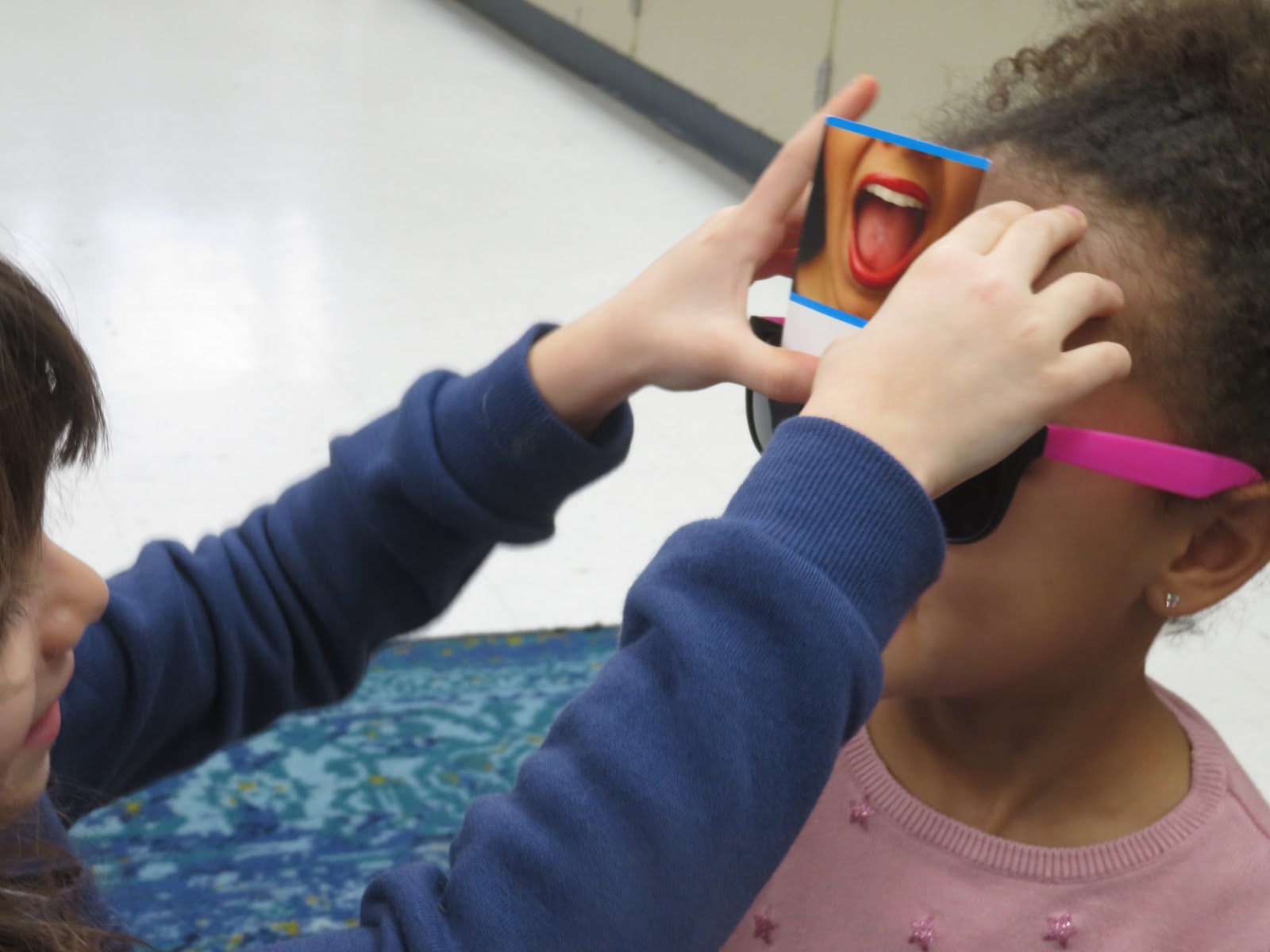
One new game introduced was, ¿Qué hay en mi cabeza? – What’s on my head? This is a guessing game that helps students improve their deductive reasoning skills through the process of elimination. In pairs, one student chooses a card and places it on the Velcro dot on the sunglasses of their partner without them looking. The student who placed the card must give clues to what is on the card and the one wearing the glasses must guess, in Spanish, what body part it is. What fun!
Another enjoyable activity was using the dry-erase lapboards. A body part was dictated and the students would draw their best impression of what they heard. During this effective, interactive and fun activity learners were able to exhibit their understanding of the concept through auditory recognition and illustration recall. Remarkable!


And, prior to the culminating activity, the young learners were offered the chance to draw on paper some of the human organs they had studied during Spanish and their homeroom class. Using books as resources for illustration of the shapes, the kindergarteners drew what they saw.


As a culminating project, the kindergarteners were provided with the opportunity to combine their vocabulary learning in Spanish class and their learning in their homeroom. We first partnered with art teacher, Amanda (who was thrilled to partner with us), and during art class each student painted a kid shaped pre-cut paper by mixing multicultural paints to create a shade that came closest to their skin tone. 


Then, during Community Time, the kindergarteners joined their third grade buddies and designed their “Human Body” using a variety of recycled materials that Amanda provided. As the young learners crafted their body organs, the third graders used their dexterity skills to write small and precise labels for each part, in Spanish. It was truly an amazing collaboration between academic disciplines and grade level, fostering leadership, caring, empathy and creativity! How rich! Keep a look out, as soon these incredible works of art will be displayed outside each of the kindergarten classrooms. I guarantee, you too will be amazed!

VOCABULARY of BODY PARTS:

EXTERNAL:
Ears - Orejas
Eyes - Ojos
Finger - Dedos
Hand - Mano
Mouth - Boca
Nose - Nariz
Toes – Dedo de los pies

INTERNAL:
Bones - Hueso
Brain - Cerebro
Heart – Corazón
Intestines - Intestinos
Lungs - Pulmones
Muscle - Músculo
Veins - Venas


A Design Puzzle for Kindergarten in the Art Room

Students at every grade level in the Lower School engage in design thinking in the art room. From the youngest friends balancing wood blocks to create a sculpture, to the oldest students working collaboratively to create a series of characters and sets, lower school students are developing their craftsmanship skills as well as their critical thinking skills while creating their artwork.

The kindergarteners have been engaged with playing with puzzles and games in their classroom, and that curiosity has carried over to the art room. The kindergarteners began designing their very own puzzles in art class, by coloring with permanent color markers on a blank white puzzle. The young artists picked the subject matter of their choice, but had to consider what type of drawing would make a good puzzle. 


They concluded that every piece should be colored in on at least some spaces, and that the colors should extend to the piece next to it, so that you could look for clues when doing the puzzle. Some friends were very interested in making their puzzle difficult to put together, so they carefully colored smaller shapes, while others wanted to create one larger image that would be easier to assemble. Helping students to think through the next steps and imagine designing an object for someone to use builds upon their ability to predict future outcomes and have empathy by imagining a situation through someone else's eyes. 


The kindergarteners next steps will be to design a box to contain their puzzle pieces, so they can do their puzzles (and maybe stump) their friends and family!

Fourth Grade Discovers How Quakerism, William Penn and Philadelphia's City Planning all Tie Together


Fourth graders were introduced to the history of Quakerism and its founder George Fox during social studies class these past weeks. Students watched a PowerPoint lecture and took scaffolded notes all the while asking probing questions about the state of life and freedom in England during the 17th century.


The students are continuing their study of Philadelphia through the centuries, and to understand the origins of Philadelphia they are learning the background surrounding religious freedom and William Penn’s own journey of religious conversion to Quakerism as a young man. His religious ideas, as well as his sense of city planning, helped create early Philadelphia. Students also viewed a movie about William Penn and the planning of his city.


After looking at five different historical maps dating from 1683, 1762, 1807, 1838 and 1857 the students learned how the city was laid out and expanded over two centuries. They looked at population growth and discovered when and why the city grew the way it did over time. Students created their own maps demonstrating the city's expansion through time.

This Week In PE / Health....................

This Week in PE / Health

This week in Lower School Physical Education.  We worked on some small sided games in grades 3 and 4 that incorporated many different skills through varied sports, such as passing, dribbling, throwing and game strategy.  In K-2 we worked on manipulation of Hula hoops as well as tag games that worked on our quickness, fleeing and game strategy as well.

This week in Lower School Health; We worked around the topics of nutrition, sportsmanship and playing fair.


4th and 3rd Grade PE really focused in on build up basketball games using a strategy game called "Volcano".  This game really focused in on the skills of passing, cutting, dribbling as well as scoring.  This game helps to develop those same skills that would be used for a game such as basketball.  Along with this we were able to play some small sided basketball games as well, we worked on the many skills involved in a game of basketball.  The new Berman Athletic Center really supported us as were able to lower hoops for students that needed some extra support reaching the basket.

K-2nd grade PE really focused in on manipulation of Hula hoops as well as cooperative games over the past two weeks.  Cooperation is something that is ever growing in Lower School PE and it is something we like to work on regularly to continue building these important skills.  Along with this we used some time to work on basketball skills such as dribbling passing and shooting.  The hoops were able to be lowered, which helped many students along with the difficult task of shooting a basketball.

Overall it was another tremendous two week in Lower School PE and Health.  We look forward to continue building our skills in the next two weeks that are approaching.  Have a happy, happy weekend!

Picture Dictionary in Kindergarten

There are many fun ways to explore literacy skills development in kindergarten.  One of the activities we engage in is called Picture Dictionary.  Students join their teachers to work on their Picture Dictionaries.  This activity highlights many of the important teaching and learning techniques that we use in kindergarten.

For Picture Dictionary pages, the students write each letter in upper and lowercase and then generate ideas about which words begin with that letter.  This process can be collaborative and fun, as the students willingly offer help to friends think of words that start with that letter.  They then choose three words and proceed to draw three corresponding pictures.  They have to sound out each word and write it next to the picture.  After they have completed these three steps, they tell us the definition of each word, and we write the definitions on their page.  This activity develops handwriting/fine motor skills, phonemic awareness, and expressive language skills.


The students love this activity.  They are quick to begin brainstorming words, and we are able to work with them in small groups.  By giving the students individual attention, we are able to scaffold their skills development more effectively.  Cultivating a love of learning is an essential keystone in our kindergarten curriculum.

Friday, January 17, 2020

Heroes and Mittens

First graders are getting started on their months long exploration of heroes. They began this venture over winter break talking with their families about values and what they thought made someone a hero. Upon our return from break, we shared those ideas and brainstormed a list of qualities that exemplified a hero.  Here are some of those ideas: being kind, changing people's thoughts, helping/saving people, plants and animals, being brave, creative, amazing, helpful, thankful, determined, teaching new ideas, being loving and being a leader.

We have been reading a variety of non-fiction books about different kinds of heroes and talking about how they are alike and how they are different.  We learned about Willie Bentley who would spend winter after winter determined to photograph snowflakes and the beautiful, magical world he opened up when he finally did.  We read about Gandhi and his persistent, diligent quest to teach about peace and positive actions for change, about a young girl named Ruby who would be one of the first young women to attend a university in China and Emmanuel who rode his bike having only one leg to pedal around the entire country of Ghana and continues today to raise money and awareness for the rights of those who live with disabilities.

Today we read The Mitten Tree by Candace Christiansen.  A gentle fiction story about an older woman, Sarah, who knits mittens for children in her neighborhood without them knowing who she is and the kindness that happens in return which is a mystery as well.  Afterward, the students noticed many qualities in the story that made Sarah a hero even though no one in the story knew that she was.

It was so rich that they recognized that someone can be a hero without being famous or even recognized for the good that they are doing.  We hope that they will continue to notice this all around them.  And we can't wait to hear all about the heroes that they will each choose to study!

After our story today, we had a chance to pull in some math and revisit symmetry by making mittens and our own mitten trees out in the hallway.  We will be adding a Willie Bentley touch to our trees by making some snowflakes as well. Take a look and think about the warmth of mittens, the magic of snowflakes and the miracle of heroes.


Hello, Neighbor-Winter Program Reflecions


When our musicians, performers, artists and actors returned from the Winter Break, we took some time in music class to do what many professional performers do after they perform-reflect on their performance.

Here are some of the thoughtful reflections our students share from the First-Fourth grade Winter Program, Hello, Neighbor:

"I really liked that we got to make up all of the dance moves."-Third grader

"I was not as nervous this year becausei have been on stage a lot of times before doing the Winter Program"-Second Grader

"I was nervous because I was not able to find part of my costume, but I just kept going and was able to do the dance. My mom said that she did not even notice."-Third grader

"I was nervous at first, but once I saw my mom and dad smiling at me, I felt a lot better!"-First grader

"The lion dance was cool because we had a partner and we got to work together. I was really looking forward to it"-Third grader

"I noticed that we really grew and got better over time."-Third grader


Fourth grade actors reflected on their experience working through the acting process, learning lines and building their stamina to wait for their parts and to wait when the teacher was working with another actor on their part.

Narrators reflected how practice really helped them to be more expressive and tell a story. The fourth grade transisiotn musicians marveled at how important they realized their part was, when at first, they thought it might be easy and boring. But in fact, it took a lot of focus and concentration, and they had to always be at the ready to provied the music that connected all of the parts of the show together.

All students commented on how they felt like they grew from last year to this year, gaining more independence and doing more challenging pieces and dances as they got older.

I was incredibly proud of all of their hard work!

See you for our Spring Program in May!:)