Friday, January 27, 2017

Second Grade's 3D Amulet Printing

As an extension to our Ancient Egypt study, the second graders are in the midst of creating and printing Ancient Egyptian amulets that we have been studying using the 3D printer in our maker space. The maker space provides the students an additional opportunity to explore their amulet through the many different aspects of STEAM (Science, Technology, Engineering, Art and Mathematics).


Each student researched and explored Ancient Egypt books in our classroom library researching two different amulets, the Ankh and the Eye of Horus. The students learned about each amulet and what it represented to the Egyptians.  After discussing the many different aspects of the amulets, the students chose either the Ankh or the Eye of Horus.

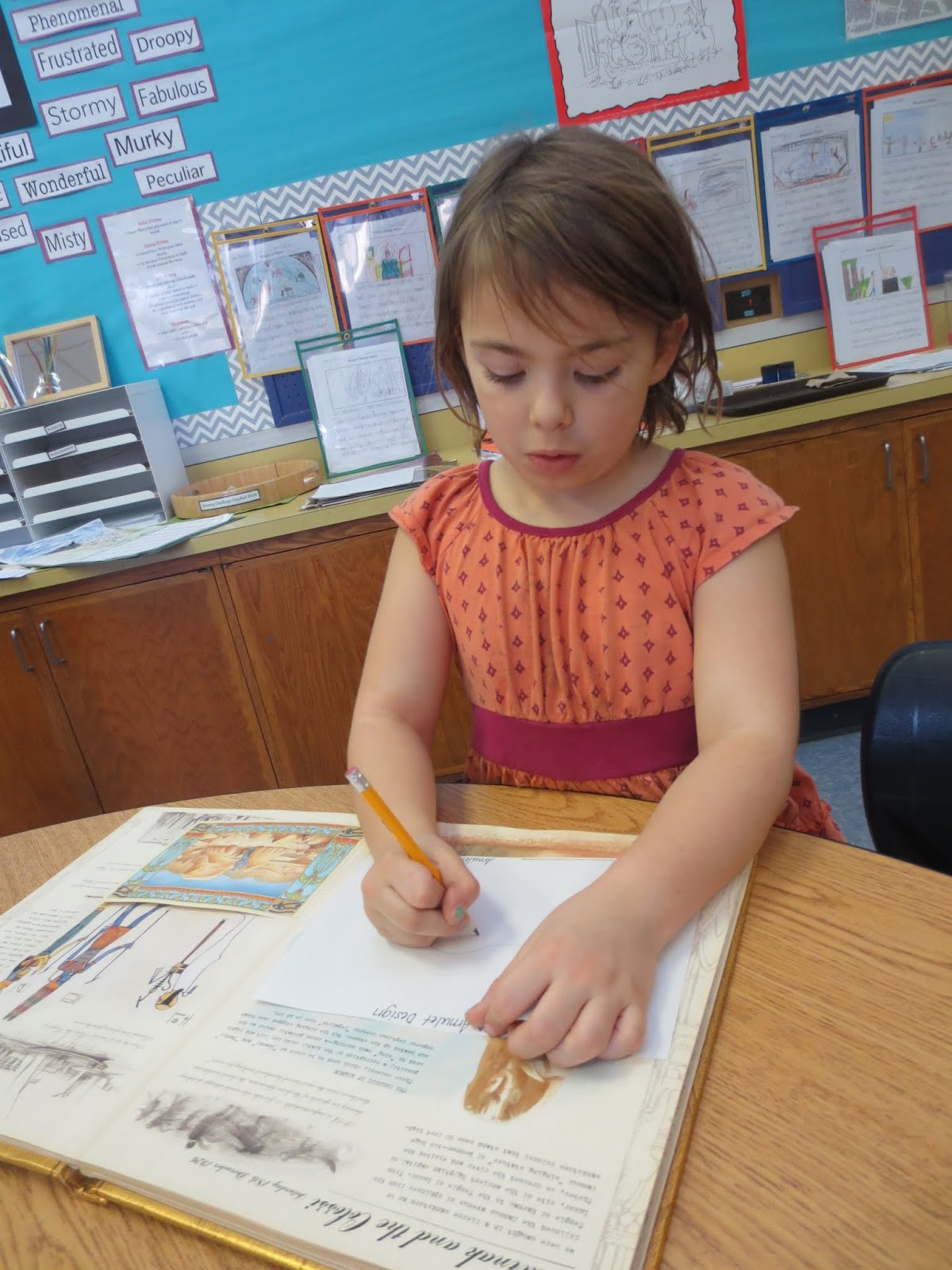
The second graders began the drawing process by drawing a 2D version of their amulet on a piece of paper. This process incorporated the “A” into STEAM!  


Next, the students used an application on the classroom iPad called Morphi where they replicated their image by sketching their amulet with their finger. The students added many details, making sure their drawing best represented their amulet’s true shape.


Once their sketches were completed, we headed to the maker space to get started on our 3D printing. First, the students chose the height and width of their amulet they would like to print. After their amulet was measured to their liking, they programmed the temperature of the printer to 190 degrees for filament and 50 degrees for the bed and hit print!


The second graders watched on with great excitement as their amulet began to take shape. This project was very exciting because it allowed the students to incorporate the many different aspects of STEAM learning. We hope you truly enjoy our 3D amulet collection!

SPCA Visits Kindergarten

Gathering the generous lower school donations
As part of their animal study, the kindergarten students have been collecting donations from lower school families for the homeless cats and dogs of the Montgomery SPCA. For the past two months, the animal lovers have been sorting and counting the many contributions for their cause. This week the excitement was at its height as the students prepared the collection for two special visitors from the SPCA, Steve the humane educator, and his dog Faith.

Sorting and organizing the collection


Counting all of the items in the bar graph begins

Taking pride in their hard work

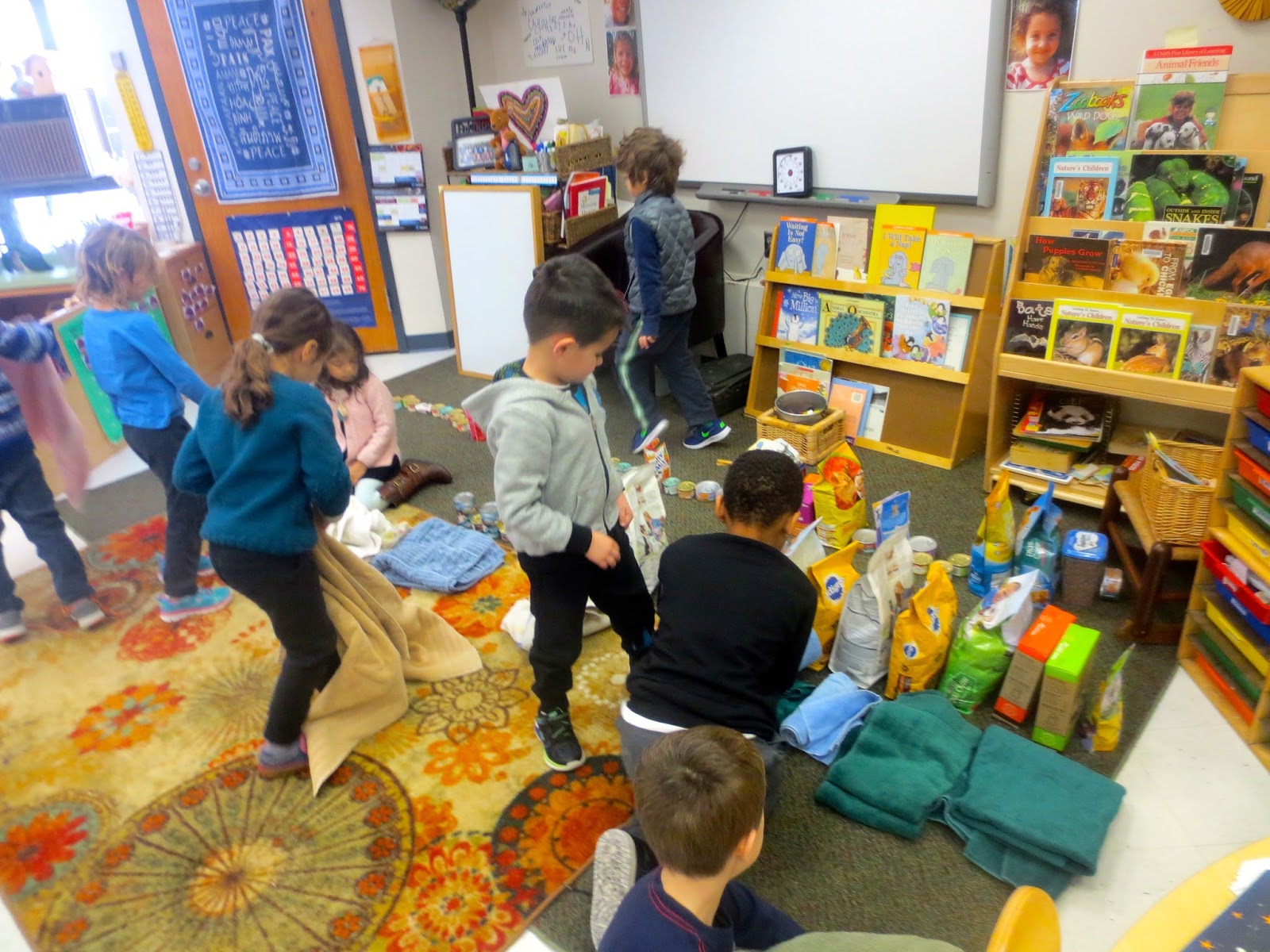
First, all of the donations were carried into the classroom by some very strong kindergartners. Then the students took turns sorting the food, bedding and cleaning supplies into categories to create a bar graph on the floor. Predictions were made as the mathematicians worked.

How much did we collect?
Which group has the most?
Which group has the least?

The donations came in varying sizes so it was not a true visual bar graph and the students had to work in small groups to count the total in each category.

After several re-counts for accuracy, the class came up with the following totals:

50 cat food items
22 bags of dog food
1 bottle of Febreeze
4 large bags of newspaper (the children did not want to count the newspaper!)
17 towels for bedding
17 rolls of paper towels
1 collar and leash
112 total items donated

The kindergartners were so proud of all the donations collected for local homeless dogs and cats.

Steve, the SPCA humane educator, and his companion Faith

The best part of the visit, petting Faith
 In the afternoon, the kindergarten classes were ready for their special visitors. It was so difficult for them to contain their excitement, yet the students worked hard to wait patiently and calmly! Steve and Faith arrived and began their presentation on animal safety. We learned that you must always ask to pet a dog you do not know for some animals get scared and all are not friendly. Then the children practiced folding their fingers under and putting out the back of their hands for Faith to sniff. Then using two fingers, they were able to pet her chin, stomach or head. Faith's eyes and and back could not be touched for it could startle her.

Standing like trees if a strange dog approaches
Steve then talked to the kindergarten classes about what they should do if they are chased by a dog or if an unfamiliar dog comes up to them. The kindergartners learned that they should stand very still like a tree so, of course, tree standing had to be practiced! The kindergarten students were quick and eager learners and listened carefully to the pet safety tips that Steve shared with us.

Helping load Steve's van with our donations
 for the trip back to the SPCA
Before Steve left he answered questions and shared a recent story about the SPCA. Unfortunately, over the weekend, there was a fire at their Conshohocken shelter and the animals needed to be moved  to their other facilities in Perkiomenville and Abington. We were so happy to learn that none of the animals were hurt and everyone was safe. All of the items that the kindergarten collected would go to help all of these animals while they waited for new homes. At the end of the visit, the kindergarten students proudly carried the donations to Steve's van for the trip back to the SPCA.

This project all began with a deep love for animals that arose out of an authentic interest of the children. The SPCA service learning project integrated many aspects of our curriculum as the children practiced literacy, language, art, math and social skills. Art and writing skills were utilized as individual collection boxes and posters were created to start the project. Speaking skills were strengthened as kindergarten friends went to lower school classrooms to share their idea and ask for help from others with the collection. Cooperative social skills were necessary as students worked together to organize and sort items. Math skills were evident as a graph was created, predictions were made, and then data interpreted.

The power of the children's passion for animals was expressed fully and actively as they engaged in this experience. Empathy for animals and their needs was clearly evident and with individual and collaborative efforts, the  kindergarten students were able to put a voice to their ideas and make a difference in our world. The kindergarten students thank all of you who contributed generously to the SPCA collection. Remember if you would like to adopt a cat or dog, look to the SPCA for their homeless cats and dogs make wonderful pets!

Thank you!

Love,
Kindergarten

Tuesday, January 24, 2017

Third Grade Stick Passing Game

Students in third grade learned the Ghanaian song "Tiriba Ya." The loose translation of the song is  "Come and dance/play." This summer, I learned this song and a stick passing game that was created by one of my master teachers. This is NOT a traditional West African nor Ghanaian stick passing game, however, it is similar to some of the stick or stone passing games you might see played in the region.

Below are 3 videos that show 3 different stick passing patterns the third grade learned.  Each pattern increases in intensity and difficulty.

Pattern #1: This is a simple pattern where students play a repeated rhythmic pattern and just pass the sticks to their neighbor. Tap-Tap-pass


Pattern #2: In this pattern, students alternate between performing the pattern with the sticks then playing the pattern on their bodies, also known as body percussion. The sticks are still passed, but you only use them every other time. 


Pattern #3: In this pattern, sticks are taken out and every other person has the sticks. If you have the sticks, you perform the pattern using the sticks then pass. When you do not have the sticks, you perform the pattern using body percussion. So students had to alternate between two different ways of performing the patterns in quick succession. 


Third grade did a fabulous job and we had a great time! Enjoy!

Shaping Up in First Grade

In our most recent math lessons, first grade has been learning about the specific attributes of plane shapes and some fractions associated with these shapes.  We were puzzled trying to explain the subtle differences among a square, rectangle, rhombus and trapezoid since they all have four sides and four angles but the students were astute and were able to identify what made them each unique.  In one activity, the students worked cooperatively in small groups with pattern blocks to find out what different fractions could be discovered for each different shape by using smaller blocks to fill in the larger blocks.  The thoughtful discussions and excitement of discovering that occurred throughout the activity were wonderful! We even uncovered some new fractions! We figured out 1/6, 1/3, and 2/3!!


The students proudly shared their discoveries with one another and then went on to explore what creations they could make with all of these shapes!  We will soon be taking our shape unit to a new dimension, literally.  We will be exploring 3-D shapes or 'solid shapes' as they are called in our math books!

Second Grade Time Travel

The second grade students have embarked on their trip back in time to ancient Egypt!  We started by asking what the students might think they already know about this amazing civilization, and it was wonderful to note that many of them shared things they had learned from last year's second grade class when they gave "Egypt Tours!"  Next we generated a list of questions they want to try to answer throughout the study.  Some of them included:

"Did they have toys?"
"How did they build the pyramids?"
"Did they have hospitals?"
"What kind of animals lived there?"

Reading parts of Egypt in the Past and Present aloud, provided an overview of the big ideas that we will be covering in the next few months.  Each student then received a new "Explorer's Notebook." This little book will give them a place to collect information and sketch when they learn something new! Using their experience of researching birds earlier this year, the students brainstormed categories that will help them organize the information they find.  They decided that many of the same categories apply, such as diet and appearance and adjusted others to fit more appropriately, such as making habitat into houses.

Many great books and "artifacts" have also appeared in the classrooms and are being explored by the students.


Nuestros autorretratos / Our self-portraits

And they are finally done!!! One of the many ways in which a positive sense of self is nurtured in Spanish class is by providing all students with the opportunity to create his or her autorretrato (self-portrait).
To commence the autorretrato project, the students were taught some of the Spanish terminology and concepts associated with portrait painting. Students learned in español some of the body parts with an emphasis on facial characteristics as well as colors and shapes. Many books were read, plenty of songs were sung, some activity sheets were completed and numerous games were played that helped the learners practice the Spanish vocabulary for these themes, orally and in writing.

To culminate the self-portrait project, we read Katie Kissinger’s book that provided positive exploration and celebration of skin color differences, "All the Colors We Are – Todos los Colores de Nuestra Piel." Afterwards, mirrors and multicultural colored tissue paper, markers, crayons, pencils, buttons and yarn were provided. As the students observed themselves in the mirror to look at their facial features and small details, the students were encouraged to discuss qué color (what color) comes closest to their piel (skin), ojos (eyes), cejas (eyebrows), pestañas (eyelashes), labios (lips) and pelo (hair).


Along with the self-portrait, a short autobiography of each student has been added. This layer of the project provided an additional opportunity for more learning in español. In the younger grades, students were introduced to Lynn Reiser’s book, Margaret and Margarita. This is a cute story about two little girls that meet at the park, one speaks English and the other speaks Spanish. When the two children meet, they find a way to communicate. The story helped introduce students to phrases such as me llamo (my name is) and me gusta (I like). We also read Audrey Wood’s book, Veloz como el grillo (Quick as a Cricket). This book reinforces the concept of individuality and feeling good about one’s self. The tale provided the students with the opportunity to learn the term yo soy (I am). Afterwards, when the students were "interviewed" for their autobiografía, they were able to respond to the following:
¿Cómo te llamas? (How are you called?)
¿Qué te gusta? (What do you like?)
Yo soy______ (I am _____)
The students in the 3rd and 4th grade were encouraged to write their autobiography in English and Spanish. The dictionaries and iPads were used as resources to help with translation as they completed the following;
Me llamo… (I am called…)
Mi cumpleaños…. (My birthday…)
Yo soy… (I am...)
Yo tengo… (I have…)
Me gusta... (I like…)
Please stop by! I encourage you to come to our Spanish classroom and marvel at all “the colors of us!”


Wednesday, January 11, 2017

Kindergarten Picture Dictionarty

There are many fun ways to explore literacy skills development in kindergarten.  One of the activities we engage in is called Picture Dictionary.  Every Tuesday and Thursday, we are visited by Susan Niescier, who is a Literacy Specialist from Montgomery County.  When she is in our classroom on Tuesday, half the students work with her doing fun activities to strengthen reading and writing skills.  The other half join their teachers to work on their Picture Dictionaries, and on Thursday we switch groups.  This activity highlights many of the important teaching and learning techniques that we use in kindergarten.  We often design activities that are collaborative, fun, and student centered.


Each week we work on a new letter.  The students write each letter in upper and lowercase, and then,  they generate their own ideas about which words begin with that letter.  They choose three words and proceed to draw pictures.  Then they have to sound out the word and write it next to the picture.  After they have completed these three steps, they tell us the definition of each word and we write the definitions on their page.  This activity develops handwriting/fine motor, phonemic awareness, and expressive language skills.


The students love this activity.  They are quick to begin brainstorming words, and we are able to work with them in small groups.  By giving the students individual attention, we are able to scaffold their skills development more effectively.  Cultivating a love of learning is an essential keystone in our kindergarten curriculum.