Wednesday, October 4, 2017

Third Graders Study a Chinese Moon Folktale

Third graders have begun their study of Chinese culture by learning about and celebrating the Mid-Autumn Moon Festival. As a class, we have been reading and discussing stories and folktales about the moon to learn about its shape, phases, and beauty.
This week, third graders having been reading one of the most famous folktales of the Mid-Autumn Moon Festival, the Story of Chang-E and Hou-Yi, which explains why the moon is the biggest and brightest once every month on the full moon. The tale takes place in ancient China, at a time when ten suns took turns shining on the Earth. One day, when all ten suns rose in the sky at the same time, the imperial archer, Hou-Yi, was summoned to save the Earth by shooting the suns down from the sky. As his reward, he received a magical pill for eternal life. The story goes on to explain the brightness of the moon during the full moon time, and it also introduces several important characters in Chinese culture, including the Moon Goddess and the Jade Rabbit.  
Third graders have been working hard to learn about the folktale of Hou Yi and Chang E by retelling each step of the story through their own words and artwork. Working in partners and individually, students began by helping each other think about important steps in the story, sequence the steps in a story map, and then retell the folktale in their own writing. 


¡Bienvenidos familia, amigas, y amigos!


Welcome families and friends! Our Spanish Program for the 2017-18 school year got off to a great start! Our most important objective en la clase de español is to provide a nurturing environment where everyone feels comfortable learning a second language and to encourage all to develop an openness, understanding and appreciation for other cultures. Since the start of the school year, students have enthusiastically expressed their joy in Spanish class as they engage in playing games, greeting puppets, listening to storybooks, singing, and role-playing using written dialogues. 

As an introduction to the Spanish program that is new to most of our youngest members, the pre-kindergarten classes have been enjoying listening and practicing our traditional morning song, Buenos días amigos, buenos días (Good morning friends, good morning) and the ending of class song, ¡Adios, hasta luego! (Good-bye, until later).  Additionally, to prepare the Cardinals, Catbirds and Sparrows for the traditional beginning of class activity, ¿Dónde vamos hoy?, the students have been learning the vocabulary for some basic modes of transportation such as carro (car), tren (train), bote (boat) and avión (plane). They also got a tremendous kick out of meeting our beloved, la vaca (the cow). La vaca loves to end each class by thanking all the students for participating in Spanish class. When gently squeeze, la vaca will say moochas-gracias (thank you very much) to which we all reply, de nada (you’re welcome).

In el Jardín de Infancia (kindergarten) the students have been learning and/or reviewing los números del cero al veinte (the numbers from zero to twenty). One fun way has been using el dado (the die). Each child took a turn at tossing a plastic die with clear pockets holding a flashcard with a number. Once the die settled, the student would identify the number, in español, and lead the class in counting with a movement activity to represent the amount of the number chosen. Other than helping students enhance the concept of matching symbol with a sound, this was an excellent way for us all to get our morning exercise, teacher too, as there were lots of requests for jumping jacks, push-ups, and even burpees!

To review and reinforce previous year’s learning, in Primer (1º) Grado the students have been working with the modes of transportation.  To help us, we played the infamous game, ¿Qué falta? (What’s missing?). This is a game that fosters the students’ memory through concentration and focus. In this fun activity, miniature props of transportation were placed for all to see. They were then covered with a bandana and one object was taken away. Once the kerchief was removed, the students were asked, ¿Que falta. The students raised their hands and when picked, took a guess at stating in español which item was missing. The best part was when the students were given a turn at leading the game. They were very proud to take on the role.

To connect with their birthday month graphing activity in math class, in Segundo (2º) Grado the students have been practicing los meses (the months). After a variety of activities to practice saying the months, including viewing and listening to a catchy song on You Tube, the students were invited to an activity that required placing the months in order. They were asked to break into groups and each set was given the names of los meses in strips with the goal of placing them in order.  This activity is a fun way to help second graders build on the skill of recognizing the relationship between a sound and its corresponding written word in español.

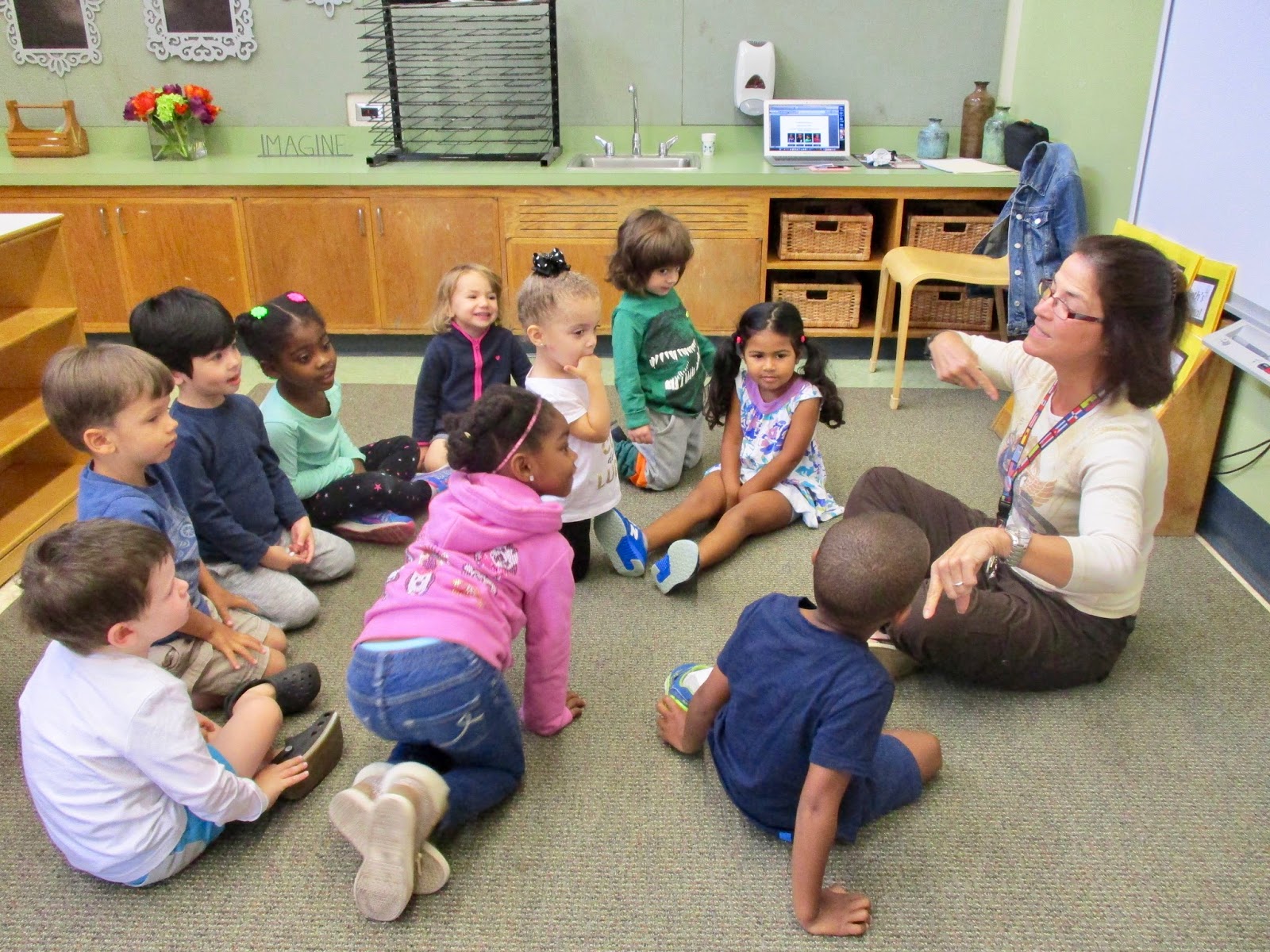
In Tercer (3º) Grado the students joyfully engaged in many activities for practicing saludos (greetings) in español. They had an absolutely fun time reading a dialogue in Spanish to one another. What made the experience even more amusing was that they used a títere (puppet) as they took turns in following the script to greet each other.

And, in Cuarto (4º) Grado the students have begun conducting research for the well-known assembly game, ¿Dónde vamos hoy? At the beginning of the school year, each fourth grader chose a country to research and determine what she or he feels are the three best possible fun facts. Before each assembly throughout the school year, one country will be chosen and the fourth grade students will state the clues, in ingles y español, to the Lower School community.  Then, all are invited to figure out the mystery Spanish-speaking country by filling out a form and slipping it in a box located outside the Spanish office, El Palacio. During the following assembly, the name of the country will be revealed.

We have definitely gotten off to a wonderful start. I look forward to the many, many adventures and experiences ahead. Hasta nuestra próxima noticias (until our next news), ¡Adiós! 

Con mucho cariños,
Alicia

Friday, September 29, 2017

Framing Perspective Through Journaling

Framing Perspective Through Journaling

This year grades K through 4 began their journey in science class by creating their own nature journals. To make them, all of the students used brown paper bags, white copy paper, colored card stock, pipe cleaners, glue, and what quickly became known as "The Mighty Mighty Hole Punch."

Students from each grade group put their  fine motor skills to the test while barreling through the challenge of not only overcoming how to properly use the hole punch but also figuring out why their holes didn't line up. The challenge was met with many verbal cues of struggle such as "Ouch, I can't do this! Can you do this for me? Help! and finally, I give up". Many hugs and words of encouragement were provided all the way through to the completion of what has become our students' most respected tool for reflection in nature, their nature journals. Nothing ventured, nothing gained.


Thus far, our students have used their nature journals to reflect upon memorable moments they spent interacting with nature over the summer. During science class, our students also took a nature walk through part of the AFS arboretum on the first day of fall and journaled about the current view of the environment. They will take a series of nature walks through our campus in the future and reflect upon how the environment changes as the seasons change.

To our young scientists I would like to say, "Be proud of your bravery through the struggle. For you have gained the skill of using two new tools, "The Mighty Mighty Hole Punch" and your beautiful nature journals!

Building Community in Kindergarten

Making new friends
  
Mixing "food" for a Gruffalo hunt

Transitioning from the long days of summer to kindergarten can be a big change for students as they encounter and navigate new spaces, faces and expectations.  Each child comes to school with a variety of needs, experiences, skills and hopes. Before the hard and important work of reading, writing and math can ensue, each student must feel safe, valued, heard and known. A strong classroom community fosters this sense of belonging and begins to build the foundation of our year together.

Indoor and outdoor informal play such as dramatic play and block building, and structured play opportunities such as collaborative group work, naturally draw pairs or small groups of children together as they share common interests and ideas. All of these are certainly important for individual growth, yet how can we connect as a larger whole class? How can each student been known throughout the class and not by just a few close individuals? How can we intentionally build community? 
Collaborative pattern block work

Sharing a common interest of drawing


One way for our kindergarten class to connect more deeply is through our daily morning meeting times as we share a different greeting each day, making everyone feel welcomed and included. While practicing looking at each other, using names and a friendly voice, the students build up necessary social skills. Next, we dig a little deeper in making classroom connections by posing a "sharing" time or question that has us learning more about each other's likes and magnifying common interests such as treasured books, weekend experiences or a favorite food. We might share around the circle, individually or use a partner share to connect. Our morning meeting then proceeds to a game or group activity that has us moving, laughing and creating a repertoire of common shared experiences. Ask your child which game is their favorite so far:  Be Still As a Rock, Busy Bees, When the Warm Wind Blows or Fruit Salad? Our intentional morning meetings set the tone for the school day while providing the place and space for building bridges and strengthening our community.
Book sharing and learning how to be an audience member and a public speaker!
Creating something together as a whole group also helps each community member to feel included and important, a part of the bigger picture. Each student created a self portrait to include in our larger kindergarten portrait. This visual representation of our class emphasizes how each individual is valued and appreciated and how we are here to take care of one another. We will be friends, learners, teachers, readers, writers, scientists, mathematicians, athletes and artists side by side, supporting and cheering each other on as we move through this wonderful experience of kindergarten together.


Being a member of a community also entails some important responsibilities. To help the students understand the effect our words and actions have on those around us, we read several books about kindness and care for others. A classroom favorite is Have You Filled a Bucket Today? The students quickly understood the metaphors about bucket filling and how your kindness fills someone else's (and your own) bucket. On the other hand, unkind words and actions can cause one to be a bucket dipper. Our class eagerly declared they wanted to be bucket fillers! 


Kid writing: A kindergarten friend's
wish for the year,
"I hope to be a bucket filler."
 
As a classroom community, we discussed why we go to school and our hopes and dreams for the kindergarten year. Ideas ranged from playing with new friends, learning more about drawing, wishing to be a bucket filler, going on field trips and learning how to write more words. We then asked the class several clarifying questions:

Can you reach your hopes and dreams on your own? Will you need help? Who can help you?

What will we need for us all to be able to attain our hopes and dreams?

What will our classroom need to look like for us to all feel safe, ready to try new things, take some risks and face challenges?

How can we have a joyful kindergarten year together?


 Their brainstorm started off with all the things the children thought we should not do at school: no hitting, no running, no mean words, etc. Intent on putting a positive spin to this very long and growing list of "should-nots," we turned the conversation to all of the things we could do at school: be kind, share, make friends, help one another. This list grew even longer and the children began to see all of the connections between their ideas. As a community, we whittled the "could and should" do list down to a short and sweet list that encompassed all the positives, making it much easier to remember! Thus, our classroom community care contract was created. The students took their community responsibilities very seriously as they signed the classroom contract, promising to work together so that everyone can reach and attain their kindergarten hopes and dreams, and so much more.

Our Community Care Contract

Each student had a hand in creating the way we envision our classroom, and it is our hope that this ownership will help each member of our community work hard to honor these shared ideals. Our community building work will continue throughout the year as the kindergartners grow together as a class and as individuals. We look forward to the joyful journey ahead as a community of friends and learners working together.

Monarch Mysteries in First Grade

The mysteries of the monarch butterfly have come to first grade!  Nearly two weeks ago, a package arrived filled with small containers that were each housing two or three tiny monarch caterpillars.  The students examined the tiny creatures with magnifying glasses and began asking questions.  "What is that green goop?"  "Why are they so tiny?" "Why do they have so many antennae?" And their research was underway. The questions and wonderings continue and are recorded. We also made a list of the things that the students 'knew' about monarchs after the caterpillars first arrived. We are discovering some answers and new information already!

Each day the students observe the changes taking place, writing about what they see and drawing detailed pictures that will become pages in a book at the conclusion of our study.  These recordings provide opportunities for the students to fully engage in the growth and development of the monarchs first hand.  They use kid writing to record their thoughts and they are fine tuning their observational skills as they draw what they see.

Learning that the caterpillars only eat milkweed, we went on a search to find some on the campus in order to satisfy the appetites of these rapidly growing larvae.  We were fortunate to find some common milkweed near the short stable by the Meeting House. Watch this video on the importance of the milkweed.

After collecting the milkweed for the caterpillars we had a chance to dissect some milkweed pods and see what was hidden inside.  Do you know what was there?  Seeds! Lots of seeds!  The students were thrilled to take their seeds home in hopes of planting them and growing more milkweed for the monarchs!

The changes taking place are magical and every morning the students arrive and go right to the boxes to see what is happening with the caterpillars and are thrilled and excited to see that many have gone into the j-stage and then become beautiful green chrysalises.  Check out this site to see the miracles that the students are witnessing.

We can't wait to see what's ahead!! Stay tuned and enjoy our slideshow!

Click to play this Smilebox slideshow
Create your own slideshow - Powered by Smilebox
Slideshow design personalized with Smilebox

Fourth Grade Explores Life of the Lenape

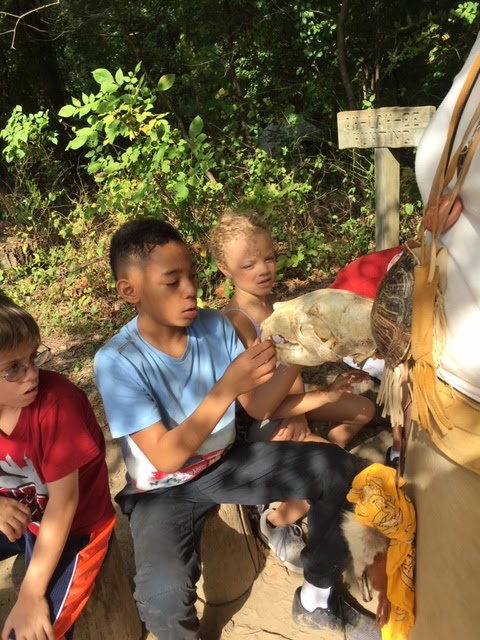
The fourth grade has been studying the indigenous people of Pennsylvania known as the Lenape. We traveled on a field trip to Churchville Nature Center this week to learn from skilled guides while traveling through a series of interpretive stations that focused on horticulture, family life, hunting skills, fire making, pottery, food and cooking, and cordage (the making of strings and ropes from natural materials) to learn how the Lenape lived. The students had the opportunity to experience first-hand a little of what is was like to live in our area as a Native American, just before contact with European settlers. The students had a chance to reflect on their visit and offered up some of the following thoughts.

“I think it must have been difficult to keep people alive because they wouldn’t know what was bad and they didn't have good medicines like we have today.”  -Clellan

“I think the men and women had really hard jobs. It would be hard for men hunting and also doing what the women say. For the women I think it would be hard to tell the men what to do and planting gardens and watching children.” -Grace

“The most interesting thing was hunting and string making. They made string out of deer tendons!” -Matthew

“I was surprised how the boy, before he went hunting, had to sit and sweat in a sweat lodge” -Brian

“Building a fire was interesting because if you are ever hiking in winter time you’ll know how to make a fire.” -Luca


examining a bear skull


mixing water to crushed cornmeal


trying on a beer skin


learning how a dugout canoe was made


making clay beads

dressing as a Lenape girl

Building Classroom Community in Third Grade


     There are a number of ways that we build community at the beginning of the year in third grade.  We play getting to know you games, establish and practice classroom routines, create 'personality portraits' to share about ourselves, and we spend time reviewing playground norms to make recess a fun and safe experience. We talk about our hopes and dreams for the year, and then we use those hopes and dreams to create classroom rules.


     Working as a group to create classroom rules helps students' to feel that the rules are relevant to them and they are more invested in following them. To begin this process, we started with a brainstorm of possible rules, which included specific rules such as one person talking at a time to more general rules like, "never give up."  We then worked together to sort the list of rules into four categories that encompassed all of the ideas.  Condensing the rules into just four was important so that they clear are easy to remember.  In our class, the rules we settled on are:

  • Be in control of yourself
  • Help and respect others
  • Take care of classroom materials
  • Try your hardest and do your best work

      Our hope is that by having rules that are fairly general, they will help students to make good choices about how they treat others and the classroom materials without feeling that they have to remember a huge amount of specific rules.  So far these have worked well as a guide for all of us as we line up for recess, play math games with a partner or have a class wide discussion during morning meeting or social studies.